Wednesday, February 24, 2010

PAY ATTENTION CLASS!!


For those of you who continue plodding along with your heads in the clouds thinking that the financial troubles of our country will all get better without intervention of us "common" folk...wise up stupid!! We have been through this in our country many years ago due to the arrogant "progressive" actions of the White House and Congress.

We must stand firm and just say "no" to the attempts to cram legislation down our throats. If you think it's bad now don't kid yourself...it could be much worse.

Here's a bit of history and food for thought.


America’s Forgotten Depression... and Roaring Recovery!

February 24, 2010 - 12:31 ET
Related Article
The Revolutionary Debt Bomb - And How the Founders Fixed It!
By Larry Schweikart

Ever hear of the Great Depression of 1920? No, me either. Do you know why? Because the recession that began shortly after World War I ended never deepened and never became “great” (as though any depression is great). There is a history lesson in that story that our leadership in Washington should keep in mind today.

As the United States, and the world, came out of World War I, the economies of the warring powers had been cranked up to full production to meet wartime demands. Suddenly, in 1918, the Armistice was announced, and within a year, troops began returning to civilian life. The influx of millions of soldiers worldwide introduced sudden unemployment, and thousands of farmers came back to farms that were already at or near full capacity, causing farm prices to fall. In the United States, Woodrow Wilson’s hand-picked successor, James Cox, the newspaper magnate from Dayton, Ohio, ran on a platform of reducing America’s wartime debt through a policy of maintaining Wilson’s outrageously high wartime tax rates.

The Progressive President Wilson had been in office when the Income Tax Amendment was passed—a story in itself. While the goal of the Progressives who favored an income tax was first and foremost wealth redistribution (not raising money to run the government), the income tax itself was largely sold to the American people on two major positive features. First, its rates were (by current standards) ridiculously low. Most people paid no income taxes at all, the bottom bracket paid only about 1%, and the very richest Americans paid only 6% (today, many states have higher income tax rates than that!). As a Vegas comedian would say, “What’s not to like?”

But it only took Wilson a couple of years of war to jack up the top rates to an astounding 73% (near confiscation) and hike the bottom rate to 25%.

Now for a little sidebar: how often have you heard that “World War II got us out of the Great Depression?” Probably more times than you can count. What is often forgotten is that when your very survival is at stake, as it was from 1941 to 1945, people will submit to most anything—rationing, confiscatory tax rates, muzzling of civil liberties. This is laudable and natural. But it is wholly unnatural and oppressive for a government to seek to maintain wartime tax levels and intrusions on civil liberties in peacetime. Hence, to return to our story, Wilson “got away” with the outrageously high tax rates during the war because . . . it was a war! Once the threat was over, however, Americans expected their country back.

Cox’s opponent, Warren Harding, also of Ohio, ran on a platform of returning the country to its pre-war “normal” economy and freedoms. While he didn’t explicitly endorse a tax cut, voters rightly inferred that’s what he meant, and sent him to the White House instead of Cox. In perhaps his shrewdest move, Harding asked Pittsburgh millionaire Andrew Mellon to be the Secretary of the Treasury. When Mellon told him he “didn’t want the job,” Harding knew he had the right guy. Mellon finally gave in, and immediately studied the recession, which was severe.

Various estimates of the 1920-1921 recession suggest that Gross National Product fell anywhere from 2.4% to a whopping 6.9%. Estimates of unemployment put the rate at between 7% and 8%. Interestingly, while most economists correctly identify the issue of returning troops as a “shock,” few note that the extremely high tax rates dragged the economy down faster than “Bernie” behind the boat (reference to “Weekend at Bernies,” if you haven’t seen it).

Mellon performed a review of another phenomenon: even though Wilson’s boys consistently pushed up tax rates, the relative return from those rates fell steadily. Without knowing it, Mellon had come up with an early version of the “Laffer Curve,” which says that at a certain point, raising taxes will result in less revenue to government, because people will silently revolt and either cease work or go into the black market. Mellon convinced Harding to ask Congress for a radical tax cut. Of course, many in government opposed. In a stunner, the New York Times of 1909 had actually warned that “when men get in the habit of keeping themselves to the property of others, they cannot easily be cured of it.”[1] Harding died in office, but his successor, the great Calvin Coolidge, remained committed to steeply reducing tax rates. Mellon, Harding, and Coolidge succeeded in reducing the top rate from 73% to 25%, and the bottom rate from 25% to 5%. There are two observations one can make: a) that’s an astounding drop, and all three men are to be commended, and b) it was still many times higher than the pre-war rates!

Nevertheless, the economy quickly recovered. Unemployment rates fell, down to 5%, then 4%, then finally, in 1926, to 1.6% according to one study. Even more shocking, the share of taxes paid by the rich . . . skyrocketed. Those earning over $50,000 (a “supermillionaire” back then) had only paid 45% of the total taxes when the rates were sky-high, but after the Mellon cuts paid 62%. Those in the “Bill Gates” category of “so-rich-they-wouldn’t-pick-up-a-$100-bill-on-the-sidewalk” rich ($100,000 at the time), saw their share of taxes paid almost double, from 28% to 51%.

We call what happened next the “Roaring ‘20s,” because the economy absolutely went nuts. Average Americans came to own cars, radio, have appliances and the electricity to power them (electricity use rose by almost 300% between 1899 and 1929), telephones, and a myriad of other products once considered luxuries.[2] Ford’s Model T, once considered revolutionary for its low cost and simplicity, now was out; General Motors, with its different car line for every income class was in. And they say tax cuts don’t work? Tell that to the Americans of the Roaring ‘20s.”

Larry Schweikart

Professor of History, University of Dayton

co-author, A Patriot’s History of the United States
[1]. Quoted in Arthur B. Laffer, Stephen Moore, and Peter J. Tanous, The End of Prosperity: How Higher Taxes Will Doom the Economy—If We Let It Happen (New York: Threshold, 2008), 49.

[2]. See Larry Schweikart and Lynne Pierson Doti, American Entrepreneur (New York: Amacom, 2009), ch. 9.

Sunday, February 21, 2010

Eat Pasta, Drop Pounds!

Despite all the negative comments about "carbs" it has been my contention for many years that you actually need (not only want) pasta and other delicious carbs. Whole grain breads and pasta are super delicious and make the meal seem extraordinary indeed with the nutty flavors.

From me to you...ENJOY!


By Lucy Danziger, SELF Editor-in-Chief - Posted on Thu, Feb 18, 2010, 4:09 pm PST

Ever tried to avoid carbs in order to lose weight and found they still follow you everywhere you go? At my favorite restaurant, the fettuccine on the menu taunts me; at my friend’s baby shower, the sandwich platter beckons much louder than the mixed greens. And in a business meeting, the cookies distract me. Whether it’s a basket of warm bread, a tasty pasta or tantalizing desserts, carbs can be hard to quit.

Thankfully, you don’t have to. Despite their reputation for helping pack on the pudge (remember Dr. Atkins?), certain carbs can actually help you feel fuller longer and fight fat. The key? Fiber—found in whole grains, oats, certain legumes and even popcorn! When people follow a high-fiber diet—at least 34 grams of fiber a day—they absorb up to 6 percent fewer calories, research shows.

Before you raid your breadbox, learn these two simple carb commandments to enjoy pasta and all your fave carbs and still peel off pounds.

Carb commandment #1: Look for whole grains. Unlike their white counterparts, whole-grain versions of rice, bread and pasta are high in satiating, fat-fighting fiber. Opt for whole-grain pastas and replace your usual loaf of bread with one that offers 4 to 5 g fiber per slice, says SELF contributing editor Janis Jibrin, R.D. For breakfast, nibble on whole-grain waffles.

On pizza night, try whipping up a whole-wheat crust at home. Order brown rice with your Chinese stir-fry, and use whole-wheat tortillas on Mexican Mondays. These subtle (and scrumptious!) swaps will help you slim!

Carb commandment #2: No need to pig out—even on whole wheat! As with every nugget of nutrition advice, moderation is key. Fortunately, whole grains contain the same number of calories as refined or white carbs, but they serve up more fiber, so you’ll be satisfied with a smaller portion, says Madelyn Fernstrom, Ph.D., author of The Real You Diet (Wiley). Go ahead and have your Butternut Squash and Fried Sage Pasta, but serve it in a cereal bowl rather than a Frisbee-sized dinner plate and stick to a 1-cup serving. Mangia!

Now that you’ve swapped your default fettuccine for whole-grain and brown rice for white, check out this list of amazing grains on Self.com for more ways to fill your cart smart.


Subscribe to SELF for less than $1 an issue.
Get a FREE Healthy Recipe Book download!

Thursday, February 12, 2009

VALENTINE'S DAY MENUS

Howdy ya'll:

These ideas for Valentine's Day menus come from FINE COOKING E-magazine. They always have wonderful delectable dishes for all occasions. Enjoy!


Forget flowers, jewelry, and store-bought candy—a home-cooked meal is the best (and least expensive) way to express those three little words. You might even offer to do the dishes, too.

finecooking eLetter
Chocolate-Hazelnut Wontons, part of the Seductive Finger Food menu.
 Love on the Menu

Whether you're cooking together or surprising your special someone, our menus—complete with recipes, tips, and shopping lists—will make it easy.


Seductive Finger Foods

Breakfast in Bed

Classic Romance Menu

Spicy Valentine's Day Dinner

Quick Dinner for Two

Browse Valentine's Day Recipes

Monday, January 26, 2009

Healing and Air Purifying Plants

I always knew I loved gardening and having plants around me...love the feel of the dirt in my hands and watching things grow...now I know that it's good for many reasons other than my personal enjoyment!!

Have a good one!


Green Eyes on: Healing and Air Purifying Plants

by Sara Snow on 01.19.09


gerbera daisies mini plants photo
Gerbera daisies and mini Gerbera daisies. Photo via flowerbud.com.

A number of years ago, NASA began to look into the air purifying properties of plants (PDF). Specifically, they were trying to find out if plants could be used to clean the air in orbiting space stations. The findings--helpful for both their purposes and ours--proved common indoor air pollutants (culprits called Volatile Organic Compounds, or VOCs, off-gasses from the likes of fabric finishes, paints, wood adhesives, and floor stains) can be mitigated or removed by way of the leaves, roots, and soil of certain indoor plants.

English ivy photo
English Ivy. Photo via Talkin Over It.

By keeping plants like Gerbera daisies, English ivy, and bamboo palm in the house, your air can actually be a great deal healthier than it would be without the plants.

New Research Shows Plants in Hospitals Help Healing
All of this is something I’ve known for quite some time. What is exciting me today is recent research showing that plants also have a tremendous healing influence on hospital patients.

And here’s why it’s so interesting to me now: For the last two weeks, I’ve spent my days with my 90-year-old stroke-recovering grandma. We’ve gone to physical, occupational, and recreational therapy appointments together. We’ve eaten meals of pureed turkey and vegetables. We’ve watched a continuous loop of wildlife scenes on the in-house hospital TV channel. We’ve read cards from well-wishers and (being the proud grandma that she is) snippets from the galley copy of my upcoming book. And we’ve marveled at the beauty of the live plants and fresh cut flowers in her room. This is why I was thrilled by the recent influx of information on the actual, scientifically proven, healing properties of plants.


watermellon grandma sara snow photo
Sara's grandma.

According to a recent study, patients with plants in their room (and we mean plants, not just cut flowers because of the longevity of the plant) began to take interest in their plants, watering and pruning them, and moving them around for better light. At the same time, these same patients took less pain medication, had less pain and anxiety, lower blood pressure, improved heart rates, and felt more positive overall about their room environment. When asked, they said they said plants were their favorite element in their rooms, versus the patients without plants who voted for the TV.

Tomorrow morning when I head back to the hospital, instead of just giving water to the jasmine plant on my grandma’s window sill, I think I’ll take it to her bedside to see if she wants to smell it or prune it. Or maybe she’ll just want to admire the way its tendrils stretch up toward the sky. Who knows, that could be the magic pill the doctors have missed.

More on Indoor Air Quality and Healing Plants


More Than a Pretty Greenhouse--Kew Gardens research into herbal remedies
Top 5 Plants For Improving Indoor Air Quality
10 Tips for Improving Indoor Air Quality
Indoor Air Quality on Planet Green
A Bicycle That Creates Clean Air AND Clean Water!
VOCs: Volatile Organic Compounds, Indoor Air Quality and Respiratory Health


Sara Snow is a green living expert and regular contributor to TreeHugger via her Green Eyes On column. She can also be seen on CNN.com on Thursdays from 7 p.m. to 8 p.m. Her new DVD Growing Green Babies is now available through SaraSnow.com.


Beans, Beans the Musical Fruit...

Being a Texas gal, I'm no advocate of becoming a Vegetarian, however, I came across this article from "Vegging Out" regarding The Bean. It's interesting to know that most people don't know how to cook beans in such a way as to eliminate the gas associated with eating them. I have know for years the "secret" and so I'll pass it on to you along with a few recipes.

Enjoy!


veg-beans image

Beans, Beans, the Magical Fruit: How To Eat Them Without the Flatulence

by Kelly Rossiter, Toronto
Food & Health (food)


I was chatting with my cousin about some health and weight problems she was having and I was stunned to discover that she almost never cooks vegetables for her family dinner. Too much trouble she said. I suggested that not only should she add vegetables every day, she should significantly reduce her meat intake and add legumes to her diet. She was vehement about not eating beans at all. Her reason? Gas.

I suspect there are a lot of people out there who feel the same way about beans.Excess gas can cause discomfort and sometimes actual pain as well as embarrassing flatulence. Judy at Savvy Vegetarian thinks that some new vegetarians give up for that very reason. People who are new to vegetarianism may well be suddenly eating a greater amount of beans and perhaps our bodies need a bit of time to adapt.

Once you understand the cause of gas, it's fairly easy to remedy. Beans contain a sugar called oligosaccharide and we lack the enzyme required to break the sugar down. When the sugar arrives in your lower intestinal tract intact, it ferments, creating a buildup of gas. The gas isn't absorbed into the intestine, so the body expels it, creating red faces all around.

tomato-lentil-curry photo

The answer to this problem is pretty simple. Cook your own beans rather than using canned, and soak them thoroughly first to allow the sugar leach out. To avoid having it re-absorbed into the beans, it's a good idea to change the soaking water a few times. Cooking the beans slowly also makes a difference. Adding the spice asafoetida, or Kombu which is a kelp or baking soda are all said to help break down the sugar. Rinse the beans after you have cooked them as well.

I also read a number of other hints that may also help reduce gas. Younger beans are better to use than older beans, and although it is impossible to know how long the beans you are buying have been dried, there are a couple of things to look out for. Beans darken with age so choose beans that are lighter in colour, and also those with fewer cracks in them. There are suggestions that grinding or mashing beans helps, and simply chewing them well makes a difference. If you are using canned beans, rinse them a number of times.


beans with chard image

Beans are such a great source of protein, fibre and nutrients, they should be a major part of everyone's diet and you can do it without the gas. You can check out the Recipe of the Week in the TreeHugger archives for lots of legume recipes such as Wine Braised Lentils or head over to Planet Green for recipes like Chickpea Salad , Bean and Swiss Chard Stew for a Tomato Lentil Curry or a Black Bean Soup.

Some of these recipes call for canned beans, but if you are going to soak them, here is a chart of bean soaking times from recipenet.

Challenge of the Week: Embrace the bean and make a meal based around a legume.

Sources: Savvy Vegetarian, About.com, AOL Canada, The Skinny On...

Monday, January 19, 2009

GUERILLA GARDENING

Thought you might enjoy this article...seems some of us will do just about anything to make our environment a bit more pleasurable. We just love Dave's Garden Newsletter and hope you will as well.

Why not reach over your personal boundaries to beautify and replenish "God's green earth" in one way or another. Take cuttings from your own plants and root them for gifts or give away landscaping plants that you may not like or want...someone would love to have them.

Have a good one!

Guerilla Gardening - What is it?

By Susanne Talbert
January 19, 2009

Equally daring and endearing, if not a little illegal, Guerilla Gardening is a movement taking some parts of the world by storm. What is it, you ask? Read on for a brief introduction to this interesting alliance of tactical growers.

Gardening picture

If you search for "guerilla gardening" on the web, you will find a plethora of rants and raves about the movement. But if you have never heard of it, then well, it's likely you'd never know about it. A definition of the term can even be found in Dave's Garden Garden Terms section, which states that guerilla gardening is "gardening on a piece of property, usually public land that does not belong to you."

Guerilla gardening is the act of gardening or otherwise improving the aesthetics of an area that has been left abandoned or unkempt and has become a general eyesore to the public. Guerilla gardeners seek to improve these areas, usually surreptitiously, by picking up trash, putting in new plants, and maintaining the space by weeding and watering. Groups of organized guerillas often form in online groups and meet under the cover of night to complete a whole transformation in just a matter of hours. Guerilla gardeners are also just your average, unplanned plant lovers who seek to improve the area in which they live. Sometimes they ask permission, sometimes they ask for forgiveness after the fact.

Image

Active "Chapters"

If you know the story of Johnny Appleseed, you know that the concept of guerilla gardening is not new. There are a couple well-known and active groups out there to know about.

Green Guerillas

In the 1970s, a group called Green Guerillas was started to combat empty and ugly vacant lots around New York City. Today the organization remains a stronghold for sustainability within city limits, championing over 600 community gardens. The organization also seeks to unify other non-profits in order to fight hunger as well as rally community gardens and organizations. The creator of the group, Liz Christy, founded a garden which is still maintained today in her name as a beautiful green oasis within New York City. You can read more about the garden's history and see more pictures here.

To read more about Green Guerillas and their fight for urban sustainability, visit their website.

Guerrilla Gardeners

A well organized movement across parts of Europe which officially calls itself Guerrilla Gardeners, was started by Richard Reynolds in London in 2004. He runs a highly trafficked blog, through which people share their personal successes and struggles of Guerrilla Gardening around Great Britain. Participants take on big brother-esque aliases such as Amanda 5637 and Andy 157. Reynolds is well known for rallying his troops with the saying, "Let's fight the filth with forks and flowers." He also recently published a book on his gardening plight called, On Guerrilla Gardening: A Handbook for Gardening without Boundaries. Other books have been published on the subject, such as Guerrilla Gardening: A Manualfesto, by David Tracey.

Image

What do they say about the best inventions result from war?

As Plato once wrote, necessity is the mother of invention...and so came about seed bombs (as referred to by Guerrilla Gardeners) and Green-aids (as referred to by Green Guerillas). This technique is not just for guerillas, but could also be used by the average backyard gardener. With a mix of clay, seeds, and fertilizer, seeds bombs make for the perfect, effortless "weapon" against hard-to-garden-in spaces such as fenced in lots or the big, wild hill behind your house.

A short video how-to on seed bombs

DG's own Sharon Brown (Sharran) wrote a fantastic article about seed balls, as they are sometimes called, if you wanted to read more.

Now that you know what Guerilla Gardening is, you might just look at the abandoned lot across the way from your work a little differently.

**Please note that this article does not represent any support or condoning of the Guerilla Gardening movement on behalf of Dave's Garden. This is purely meant as an informative piece. **

Citation:

http://www.mediarights.org/news/2008/07/15/resistance_is_fertile_its_time_to_start_guerrilla_gardening

Photo credits:

Thumbnail of guerrilla gardening - ScottBB
Wild sunflowers - btc129psu
Tree and fence - art_n_garden


About Susanne Talbert
Susanne TalbertHaving moved to Colorado from Texas a little over 2 years ago, I am on a steep learning curve in the garden these days. I am definitely learning what 'perennial' really means! My passions include thrifty gardening, vines, super-hardy perennials, and unusual foliage plants. By day, I am a high school ceramics teacher and a ceramicist and painter.

Tuesday, December 2, 2008

RECIPES: Thanksgiving Leftovers With a Twist of Tequila

This is an absolutely awesome way to prepare Thanksgiving leftovers! Our thanks to ABC Nightline for interviewing wonder chef Guy Fieri. Have a good one!


Tequila Turkey Fettucine

Recipe courtesy Guy Fieri

Yield: 1 serving

Prep Time: 20 minutes

Cook Time 10 minutes Ingredients:

1 ounce olive oil
1/4 red onion, cut into strips
1/2 tablespoon minced jalapeno
1 tablespoon minced garlic
5 ounces turkey breast, cooked, sliced
1 ounce tequila
4 ounces heavy cream
2 tablespoons freshly squeezed lemon juice
1 tablespoon chopped cilantro leaves
9 ounces fettuccini pasta, cooked
2 tablespoons grated Parmesan
2 lime wedges, for garnish
2 sprigs cilantro, for garnish
2 tablespoons diced Roma tomato, for garnish
1 teaspoon freshly ground black pepper

1. In saute pan with high heat, add olive oil, onions, jalapeno and saute until translucent.

2. Add garlic and continue to saute for 2 minutes.

3. Add turkey, lightly mix ingredients, careful not to break turkey up too much.

4. Deglaze pan with tequila, pouring around the edge of the saute pan.

5. Add cream, lemon juice and cilantro.

6. Toss together, then add pasta, and toss ingredients while adding Parmesan cheese.

Nest pasta on plate, pour sauce over pasta. Lay sprigs of cilantro over top, sprinkle tomatoes on top, and crack pepper around the rim of the plate.

Ease of preparation: intermediate


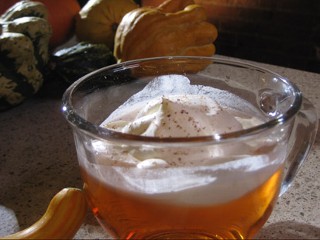
Hot Tequila Pumpkin Pie Drink

Recipe courtesy Guy Fieri

Yield: 1 serving Prep Time: 5 minutes Ease of preparation: easy

Ingredients:

1 ounce tequila (recommended: Cazadores Reposado)
1 ounce pumpkin spice liqueur (recommended: Hiram Walker or Bols)
1/2 ounce triple sec
4 ounces very hot water
1 teaspoon superfine sugar
1 ounce heavy cream
Drizzle hazelnut liqueur (recommended: Frangelico)
Small dash freshly grated nutmeg

Instructions:

1. Combine first five ingredients in clear coffee mug, stir to combine.

2. Top with heavy cream and drizzle of hazelnut liqueur.

3. Dust with grated nutmeg.